2021-09-09 <<
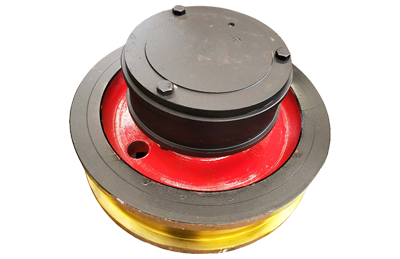
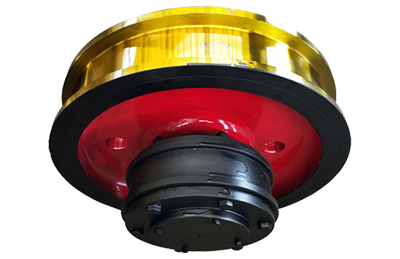
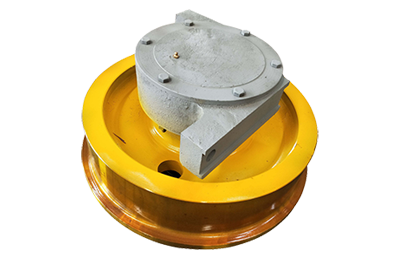
possess high strength, hardness, and excellent wear resistance. Currently, forged and rolled wheels are typically made of 65Mn and CL60 materials. Crane wheels are generally delivered after undergoing quenching and tempering treatments. Crane wheels made of 65Mn material are superior. 65Mn contains additional chemical elements such as manganese, nickel, and copper. Manganese, as the primary metallic element, enhances hardenability, reduces the tendency for surface decarburization, and improves the mechanical properties of the material after heat treatment. Additionally, most of the manganese dissolves in ferrite, forming a substitution solid solution and strengthening the ferrite.
The bearing support of the wheel set adopts an angle box structure, which is fixed to the upper bending plate of the trolley frame or the crane end beam through bolts. This structure allows for the adjustment of the wheels during use and maintenance, ensuring the horizontal and vertical deflection of the wheels to avoid wheel rail gnawing. The angle box structure is a mature technology widely used in China. The selection of wheel diameter and material is based on the consideration of the large support force exerted on the wheels under adverse working conditions, ensuring that no partial wheel overload occurs. The bearing support of the wheel set adopts a 45° split structure. First, the half ring of the bearing support is welded to the trolley frame or the crane end beam. Then, the mating surface between the integral machined half ring and the circular ring of the bearing housing is ensured, thereby ensuring the assembly accuracy of the wheels and the horizontal and vertical deflection of each wheel. After that, the wheel set is installed. This structure is convenient for installation and disassembly, has high assembly accuracy, and operates stably.